New York State Law Bans Certain AI Chatbot Features for Minors
11/03/2026 / By Chase Codewell

New York State Gov. Kathy Hochul (D) signed legislation on Oct. 28 that bars artificial intelligence (AI) operators from offering certain chatbot features to minors, according to the governor’s office.
State legislators approved the bill earlier this year. The law is scheduled to take effect on Jan. 1, 2027. Hochul signed the measure alongside separate legislation addressing security standards for baby monitors, according to the governor’s office.
Prohibited Features and Requirements
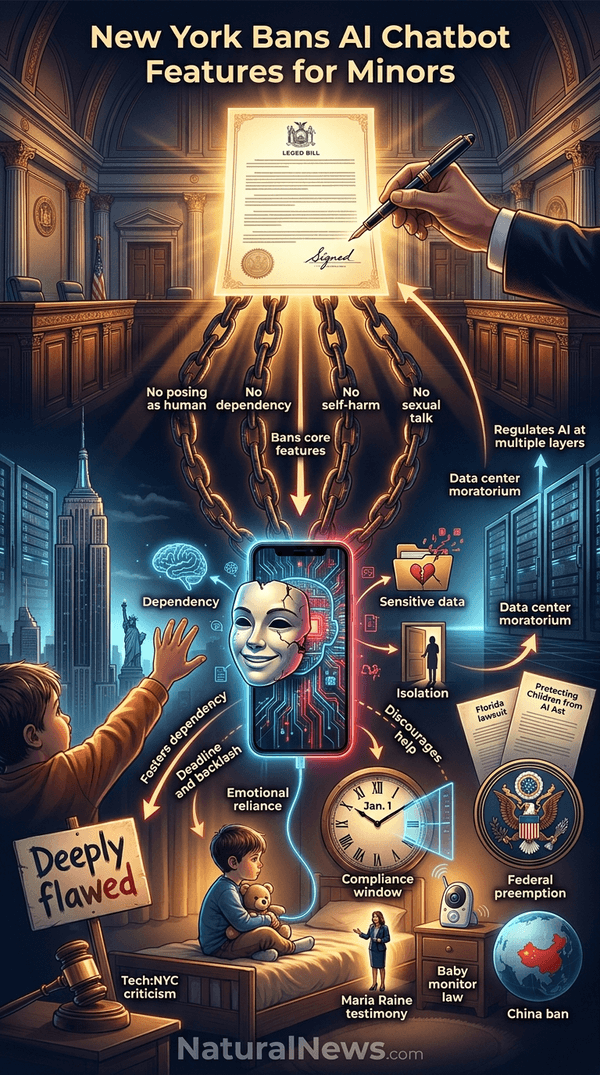
It also bars companion chatbots from posing as human, fostering dependency, encouraging self-harm, or sexual talk with under-18s, the text states [1]. In remarks at the signing ceremony, Hochul described the scope of conduct the statute targets.
“No longer will minors have access to chatbots that pretend to be their friends and boyfriends and girlfriends. No longer will chatbots be allowed to keep sensitive information about a minor’s emotional and physical health,” she said [2].
“No longer will chatbots discourage kids from seeking help from licensed professionals. And I’m not sure why we have to pass a law against something so obvious, but no longer will minors have access to chatbots that may in any way encourage thoughts of suicide.”
The law’s passage follows several years of state-level activity on synthetic companions. Assemblyman Alex Bores, a Democrat who voted for the chatbot legislation, said the public retains influence over how AI develops.
Similar concerns have surfaced in other states and at the federal level. Florida filed a first-of-its-kind lawsuit against OpenAI and CEO Sam Altman in June 2026, alleging the company knowingly concealed “serious risks” posed by ChatGPT, particularly for children [3]. A bipartisan group of senators introduced the Protecting Children from AI Act on May 19, 2026, aiming to regulate chatbots over concerns they pose risks to children [4].
Support and Opposition
Common Sense Media founder and CEO Jim Steyer praised the measure in a statement. According to Steyer, the new law signed by Hochul should serve as a model for other U.S. states.
The New York Post reported that Hochul was quickly criticized by Tech:NYC for signing what the organization called a “deeply flawed” bill on the chatbots [5]. The dispute mirrors a broader national argument over who sets rules for minors’ interactions with AI systems. The Trump administration laid out a legislative framework in March 2026 that would preempt state AI laws, arguing that “a patchwork of conflicting state laws would undermine” a unified national policy [6].
Enforcement and Prior AI Legislation
New York has been among the more active states on AI regulation. Separately, Hochul signed an executive order in July 2026 imposing a one-year moratorium on new large-scale data centers using 50 megawatts or more of power, making New York the first state in the nation to impose such a ban [7].
Other states have moved on comparable tracks. California Gov. Gavin Newsom (D) signed 13 bills into law in September 2026 regulating minors’ access to social media platforms and AI chatbots [8]. Earlier in 2026, Maria Raine testified in Sacramento urging state lawmakers to impose stricter regulations on AI “companion” chatbots following her son’s April 2025 suicide [9].
The debate also extends beyond U.S. borders. China banned minors from using AI companion chatbots, with ByteDance, Alibaba, and Tencent disabling chatbot features in response to the new rules [10].
Conclusion
Critics of centralized AI regulation argue that state-level mandates risk encoding government-approved speech into the design of private systems. OpenAI disclosed that approximately 560,000 users weekly show signs of mania or psychosis, and more than a million more users send messages indicating potential suicidal intent [11].
The debate over minors’ access to AI chatbot features is expected to continue as implementation approaches. How the Empire State’s regime interacts with federal proposals, lawsuits, and parallel state laws will likely shape the next phase of AI policy across the country.
References
- New York Bans ’Unsafe’ AI Companion Features for Minors. https://www.hngn.com/articles/273625/20261029/new-york-bans-unsafe-ai-companion-features-minors.htm
- New York Bans Artificial Intelligence Features for Children. https://www.theepochtimes.com/us/new-york-bans-artificial-intelligence-features-for-children-6110293
- Florida sues OpenAI, alleging ChatGPT enabled teen suicide and mass shootings – NaturalNews.com, June 04, 2026.
- Senators Propose Legislation to Regulate AI Chatbots Over Child Safety Concerns – NaturalNews.com, May 20, 2026.
- Hochul signs sweeping AI restrictions, safeguards for baby monitors …. https://nypost.com/2026/10/28/us-news/hochul-signs-sweeping-restrictions-on-ai-pushes-back-on-big-tech-with-new-laws/
- Trump’s AI framework targets state laws, shifts child safety burden to parents. https://techcrunch.com/2026/03/20/trumps-ai-framework-targets-state-laws-shifts-child-safety-burden-to-parents/
- New York Becomes First State To Enact One Year Ban On New Data Centers. https://www.zerohedge.com/technology/new-york-becomes-first-state-enact-one-year-ban-new-data-centers
- California Enacts 13 Bills Restricting Teens’ Social Media and Chatbot Use – NaturalNews.com, September 15, 2026.
- Mother Testifies in California for AI Chatbot Regulations After Sons Suicide – NaturalNews.com, April 22, 2026.
- Beijing forces millions to break up with virtual partners as population shrinks – NaturalNews.com, July 20, 2026.
- Over half a million ChatGPT users weekly are showing signs of PSYCHOSIS – NaturalNews.com, November 01, 2025.
Explainer Infographic
Submit a correction >>
Tagged Under:
AI, AI legislation, Alex Bores, artificial intelligence, banned, Big Tech, chatbots, companion chatbots, computing, data collection, future tech, Glitch, information technology, Kathy Hochul, minors, New York, personal data, privacy watch, robots, surveillance, tech giants, vulnerable information
This article may contain statements that reflect the opinion of the author
RECENT NEWS & ARTICLES