EU Kids Act Proposal Would Require Age Checks, Raising ID Concerns for Adults
09/20/2026 / By Belle Carter

European Commission President Ursula von der Leyen announced the EU Kids Act in her State of the European Union address in Strasbourg on Sept. 16.
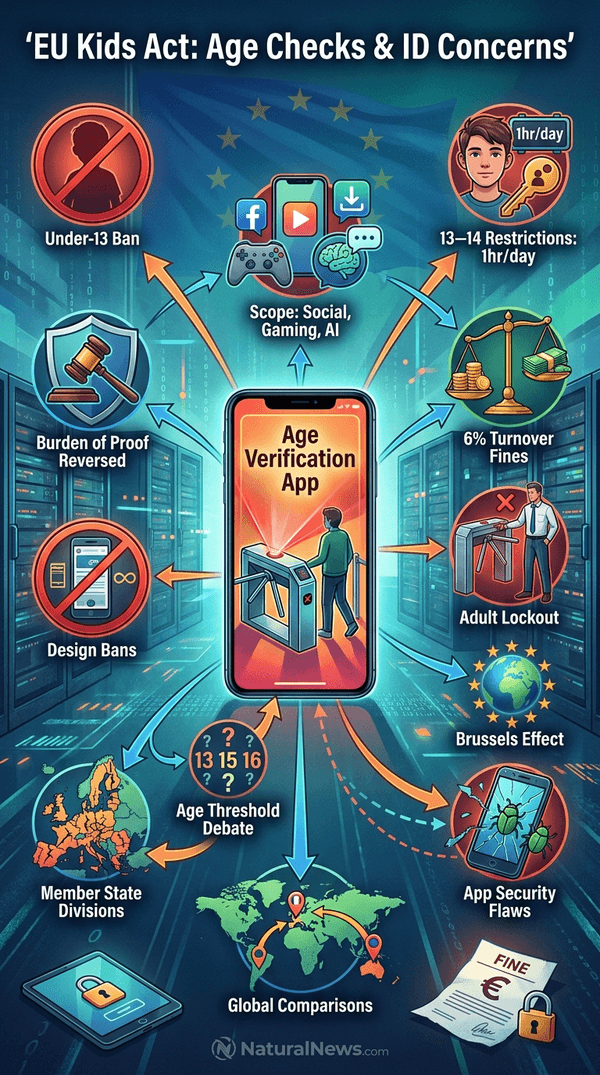
The proposal would prohibit social media use for children under 13 and require limited accounts for 13- and 14-year-olds, with parental setup and a one-hour daily time limit. Enforcement of the age limits could require age verification, a step that may lead adults to prove their age or show ID online, according to the report [1].
The announcement was made in connection with the EU’s planned digital ID rollout [1]. The proposal represents a significant expansion of EU authority over online platforms and raises questions about how age verification would be implemented and what it would mean for adult users.
Commission Proposal Sets Age Limits and Platform Responsibilities
The Act would reverse the burden of proof so that platforms, not regulators, must prove services are safe for minors, according to von der Leyen [1]. The scope covers social media, video sharing platforms, app stores, online games and AI companions and chatbots, with a focus on “high-risk” services, though that category is not yet defined [1].
Non-compliance fines could reach 6% of a company’s global annual turnover, and a supervisory fee would be introduced [1]. The draft also reportedly seeks to ban certain design features, such as infinite scrolling, autoplay, and push notifications, as well as artificial notifications and rewards, the report stated [1].
Von der Leyen said, “Europe has the power to act. It is us who decide the rules, not Big Tech” [1]. She also stated, “I am aware that many perceive the power of big tech as overwhelming and impossible to roll back. I disagree” [1]. The text is said to state that “technology companies bear primary responsibility for making their products safe” [1].
Age Verification System Could Extend to Existing Accounts
Reported rules include age checks for every new account, with existing users subject to “proportionate” checks based on subscription length [1]. Verification would be done through an app developed by the Commission or a national equivalent, and the app would only return whether a user is over or under a certain age [1].
Security consultant Paul Moore said he found the Commission app stores sensitive data on phones without protection and was able to hack it in under two minutes [1]. The Commission first said the app was ready and could be improved, then a week later described the version presented as a “demo version” [1].
The Commission’s app was presented by von der Leyen in April in Brussels, At the time, she said it was “fully open source” and that “everyone can check the code” [1]. The proposal comes as the EU plans a digital ID rollout, and the age-verification requirements have raised questions about ID checks for adults [1].
Similar measures have been introduced or proposed in other jurisdictions. Australia was the first in the world to introduce a ban on under-16s in December 2025 [1].
France in July voted to keep under-15s off social media, only to have the country’s Constitutional Council strike down the law in August as not protecting children’s data properly and being too harsh [1]. French President Emmanuel Macron then turned to the EU, asking it to come up with a rule that would apply across the bloc [1]. The French Constitutional Council ruled that the legislation infringed upon freedom of expression, according to the BBC [2].
Member States and EU Institutions Divided on Age Limits
The European Parliament earlier proposed age 16, Commission experts favored 13, and France pushed for 15. The final proposal incorporated both 13 and 15 [1]. As recently as Sept. 14, it was unclear what age the Kids Act would propose [1].
Spain, Denmark and Sweden are working on their own rules, while Estonia and Belgium are opposed to any age-based ban [1]. The divisions reflect broader disagreements across Europe about how to regulate minors’ access to social media platforms.
Lauro Fava of the law firm Pinsent Masons said the Kids Act would “be a new EU behemoth” alongside the DSA and AI Act [1]. He added that companies “will be able to comply with a single, coherent, and potentially more balanced rulebook than if they had to deal with a multitude of member state laws” [1]. The Act needs approval by the European Parliament and the EU Council, a process that can take years, officials said [1].
Approval Process and Implementation Questions Remain
The final proposal’s definition of “high-risk” services and the full scope of age verification remain unclear [1]. The Commission app’s security issues and the timing of the digital ID rollout may affect how age checks are implemented, officials and the report indicated [1].
Critics have raised concerns about the broader implications of age verification requirements. Telegram founder Pavel Durov told the Freedom Forum audience in Oslo that Western societies have already struck the iceberg and started sinking, and his remarks arrive as the British government pursues a social media ban for under-16s that functions as a pretext for mandatory digital ID and device-level scanning [3].
The Act requires approval by the European Parliament and the EU Council, and officials said the enforcement timeline is not yet determined [1]. The proposal builds on global efforts to prevent online harms to young people by preventing or restricting their use of platforms such as Instagram and TikTok [4].
References
- “EU’s Social Media Ban Could Bring ID Checks for Adults”. Reclaim The Net. September 17, 2026.
- “France’s top court blocks social media ban for under-15s”. BBC. August 14, 2026.
- “Telegram Founder: UK Social Media Ban Is Digital Iceberg About To SINK The Free Internet”. Modernity News. June 16, 2026.
- “EU Chief Calls for Bloc-Wide Social Media Restrictions for Under-18s”. The Epoch Times. September 17, 2026.
Explainer Infographic
Submit a correction >>
Tagged Under:
age verification, banned, big government, Big Tech, child safety, computing, computing chip, data protection, digital ID, European Commission, European Union, information technology, Kids Act, parental controls, privacy, regulation, Social media, surveillance, technocrats, Ursula von der Leyen
This article may contain statements that reflect the opinion of the author
RECENT NEWS & ARTICLES